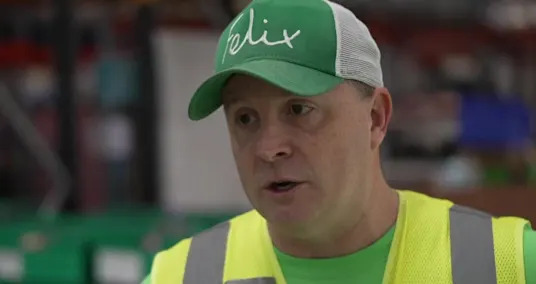
"We have big chillers that hold all of our chilled and frozen food across the city, where we'll see increased prices. We will feel a pinch and so will our charity partners downstream."
Shane Dorsett, chief operating officer at The Felix Project, said the food redistribution charity was feeling the effects of higher energy and fuel prices because of the conflict in the Middle East.
The price of oil has soared since the Strait of Hormuz - through which 20% of the world's oil trade passes through - was effectively blocked.
Across the UK, average petrol prices have reached around £1.52 a litre, about 20p higher than at the start of the conflict. Diesel has risen to just over £1.82.
That means filling up a typical family car now costs roughly £10 more for petrol and more than £21 extra for diesel.
Last year, The Felix Project rescued 18,000 tonnes of surplus food from more than 200 suppliers and delivered it to about 1,200 community organisations across London.
Dorsett said: "We've got 60 vans out on the road, so we have concerns there."

Fitbakes, a bakery based in Paddington which has products stocked in more than 2,000 supermarkets, said rising costs were making things tougher.
Its founder Ella Rauen-Prestes said after years of steady growth, the focus right now was "simply survival".
"I am seeing businesses like ours that started with us, 90% of them [are] folding," she said.
"And I think we just, we found different ways to cope."
Businesses and charities such as the Felix Project are calling for government support while the situation in the Middle East continues.
On Wednesday, Prime Minister Sir Keir Starmer said dealing with the economic consequences of the Iran war would "not be easy".
So far, the Labour government has announced extra money to help people who use heating oil.
A Department for Energy Security and Net Zero spokesperson said: "Families and businesses will be worried about the impact of conflict in the Middle East here at home. The government is determined to fight people's corner.
"We have acted to prevent unfair practices like price-gouging, and ensure businesses get a fair deal on their bills.
"We are working to end this conflict as soon as possible, but whatever happens we'll take the necessary action to tackle the affordability crisis."
Sir Keir previously said the government would "step in" if fuel companies tried to "rip off customers".
According to the government, the supply of oil to the UK remains healthy in spite of the conflict and stressed that panic buying was not necessary.
Listen to the best of BBC Radio London on Sounds and follow BBC London on Facebook, X and Instagram. Send your story ideas to [email protected]
LATEST POSTS
- 1
 Best Quest for new employment Site for You to Track down Amazing open doors
 - 2Let them eat (Taylor Swift) cake: The baker turning A-listers into life-size desserts
- 3The German series proving subtitles can be sexy — and wildly addictive
- 4The Force of Positive Reasoning: Day to day Attestations
- 5Hezbollah sees potential win as Israel backs down from disarmament goal


- Wizz CEO: We’re going to invest $1 b. in Israeli market
- 'An incredible privilege and responsibility': Artemis 2's Christina Koch is ready to become the 1st woman to fly around the moon
- April’s full pink moon will rise in the night sky this week
- Israel reports first missile fire from Yemen since start of Iran war
- The most effective method to Shake Hands During a Pandemic: Wellbeing Tips and Behavior
- Nine in 10 German industrial firms expect Iran war to hit business
- More than half way to the moon, the Artemis II astronauts are grappling with a toilet problem
- European Travel Objections for 2024
- Can a mammogram help identify heart disease?