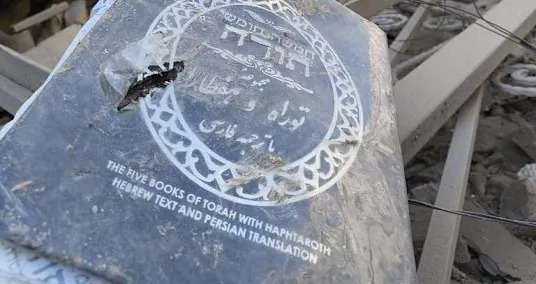
Footage and reports circulated by Iranian outlets and social media accounts identified the site as the Rafi Niya Synagogue, located near Palestine Square in central Tehran.
A synagogue in central Tehran was damaged in a missile strike attributed by Iranian media to the ongoing US-Israeli campaign, according to Iranian state and semi-official reports published on Tuesday, with one of Iran’s Jewish representatives condemning the attack and saying Torah scrolls remained buried under the rubble.
Footage and reports circulated by Iranian outlets and social media accounts identified the site as the Rafi Niya Synagogue, located near Palestine Square in central Tehran, an area that has seen repeated strikes in recent days. This was confirmed toThe Jerusalem Post by independent sources, who told the Post that a member of the Tehran Beit Din, Rabbi David Sasani, had been seen at the site, evaluating the damage.
Videos released by Iranian state-linked media appeared to show siddurim (Jewish prayer books), debris, and damage inside the building after the strike.
According to IRNA English, Iran’s official state news agency, “a few hours ago, the Jewish synagogue near Palestine Street in Tehran was targeted by Israeli fighter jets,” adding that the site, which it identified as the Rafi Niya Synagogue, had been “significantly” damaged. Iranian state broadcaster IRIB News and other affiliated reporting also carried claims that the synagogue had been struck.
In a video statement carried by IRIB News, Homayoun Sameh, the Jewish representative in the Majles (Iranian parliament), said the strike had hit “one of our ancient and holy synagogues” during the Jewish holiday of Passover.
“The Zionist regime showed no mercy towards this community during the Jewish holidays and attacked one of our ancient and holy synagogues,” Sameh was quoted as saying. “Unfortunately, during this attack, the synagogue building was completely destroyed, and Torah scrolls remain under the rubble.”
A Persian-language video shared online and translated from a clip reviewed by The Jerusalem Post also appeared to show a man standing near the damaged site in Tehran claiming that a synagogue adjacent to the residential area had been hit and accusing Israel of demonstrating that it “makes no distinction between Jews and Muslims.”
The location shown in Iranian reporting appears consistent with the area around Palestine Street and Palestine Square in central Tehran. A map listing for the Rafi Niya Synagogue, reviewed by the Post, places the site in that vicinity, close to the area referenced in Iranian coverage.
Pro-regime accounts quickly spread footage of the damage
Iranian and pro-regime accounts quickly used the reported strike to accuse Israel of targeting Iran’s Jewish minority, even as Iranian officials continued to frame the broader war as one between the Islamic Republic and the “Zionist regime,” rather than with Jews as a people.
One social media post circulated by Iranian-linked accounts claimed local Jews had said they were “not surprised” and that “anything is possible from Israel.”
Tehran has long sought to present itself as a protector of its remaining Jewish community while simultaneously maintaining fierce anti-Israel rhetoric. Iran’s Jewish population, now only a fraction of its pre-1979 size, remains the largest in the Middle East outside Israel and, under the constraints of the Islamic Republic, is often publicly critical of Israeli policy.
At the time of writing, there was no independent confirmation of the full extent of the damage, nor was it clear whether the synagogue itself was directly targeted or whether it was damaged as a result of strikes on nearby sites in central Tehran.
Neither Israeli nor US officials had immediately commented publicly on the specific Iranian claims regarding the synagogue.
LATEST POSTS
- 1
 Artemis 2 astronauts reveal adorable zero-g indicator 'Rise' | Space photo of the day for March 31, 2026
 - 2Canada Awards C$1.5 Billion Defense Contracts to L3Harris, Airbus
- 3The Best Games On the planet
- 4Global measles cases drop 71% in 24 years as vaccination coverage improves, WHO says
- 5Picking the Right Home Machines: A Commonsense Aide



- From blowouts to big interiors, ‘Tuscan Mom’ style is Gen Z’s answer to beige burnout
- Flu activity rises sharply across US with 7.5 million cases, CDC data shows
- Vote In favor of Your #1 Method for diminishing Pressure
- A definitive Manual for Choosing Indoor Plants Ideal for Your Space
- Exploring School Life: Self-awareness and Illustrations
- Man who grabbed Ariana Grande at 'Wicked: For Good' premiere also rushed Katy Perry onstage this year. Who is he and why is he doing this?
- Shah Capital pushes for Novavax sale, warns of proxy fight
- Tear gas and arrests: Iranian regime continues crackdown on protesters amid economic unrest
- Dick Van Dyke shares his secrets to longevity as he turns 100